We’re searching more, but differently
Alphabet just had the worst day in its history — and it wasn’t because search shrank. We’re searching more than ever. We just stopped clicking. A short read on the shift to AI answers, and what it does to the search economy.
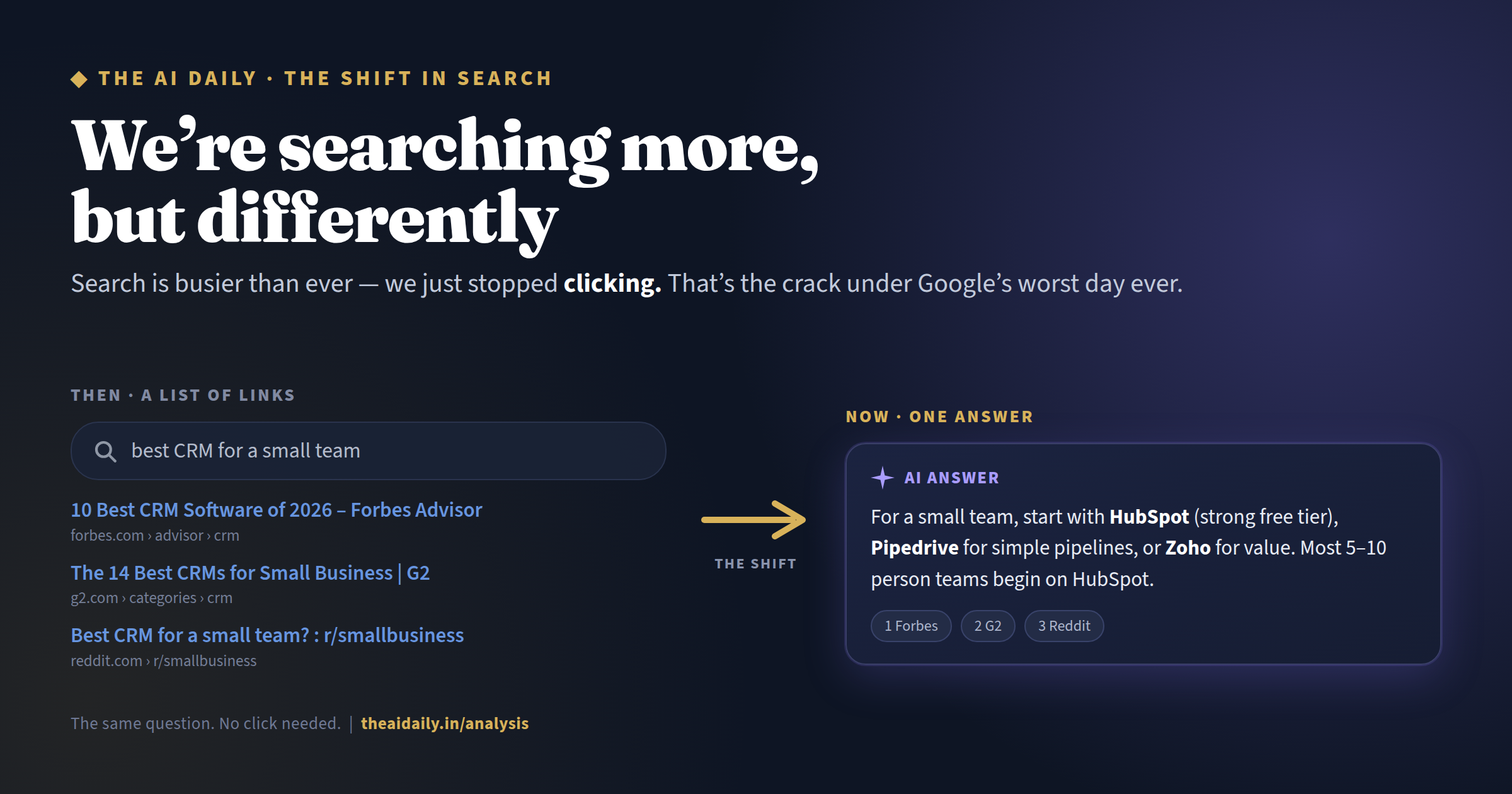
The same question, no click. Multiply that by five trillion searches a year, and you reprice the open web.
For three years the debate was theoretical: does AI search eat Google, or feed it? On Thursday, Wall Street stopped waiting. Alphabet shares fell about 13% — the steepest single-day drop in the company’s history, roughly $500 billion in market value gone — even though the quarter it reported was, on paper, enormous: revenue up 25% to $127.6B. The market didn’t care about the top line. It cared about which line was slowing.
How Google actually makes money
Still, overwhelmingly, from ads. Strip the quarter down and the picture is a spectacular new growth engine bolted onto a business that lives or dies on one number.
Advertising (Search + YouTube + Network) is still roughly two-thirds of Alphabet, and Search alone is about half. Cloud is the fast-growing engine — up 103% — but it is not yet the business the company rests on. Source: Alphabet Q3 2026 results.
Search & other is about half of all revenue and the profit engine that funds everything else. Add YouTube and the Network and advertising is ~64% of Alphabet. Cloud — up 103% to $30.7B — is the growth story and now about a quarter of revenue, but it is not yet the business the company rests on. So when one line wobbles, it matters more than its size suggests: that line is Search.
The number that cracked
Search grew 12% — fine in isolation, alarming in sequence.
Twelve percent is a big number in isolation — and an alarming one in sequence. Search growth missed estimates two quarters running. Source: Alphabet quarterly results, 2026.
It was +19% in Q1, +17% in Q2, now +12%, and it missed estimates for the second straight quarter. Management’s own explanation is the tell: users are shifting to AI Mode, and those AI answers monetise more slowly than ten blue links. Google has 1B+ people in AI Mode and 2B+ seeing AI Overviews — it is winning the usage war inside its own product and losing revenue per query doing it.
The impact on the search economy
The whole search economy is a tower built on one small action: the click. Ads are sold against it, publishers live on it, and a multibillion-dollar SEO industry exists to earn it. Pull the click out and the tower reprices — which is exactly what has started.
- Publishers feel it first. For two decades, ranking on Google was free distribution. Now, where an AI answer appears, the top result loses more than half its clicks, and roughly two-thirds of searches end without a visit to anyone. The traffic newsrooms and niche sites were built on is draining — which is why many are now cutting content-licensing deals with AI firms instead of chasing rankings.
- SEO becomes “get cited, not ranked.” The game shifts from being link #1 to being the source the model quotes in its answer — a nascent craft people already call generative-engine optimisation. Being in the answer starts to matter more than being on the page of results.
- The ad model has to move with the answer. Search ads are Google’s crown jewel, and they live on the results page. If the answer replaces the page, the ad has to live inside the answer — and no one, Google included, has yet learned to do that at the old price. That gap — usage up, money-per-query down — is the whole of Thursday’s 13% fall.
So the search economy isn’t collapsing. It is moving — from a marketplace of links to a marketplace of answers. The value doesn’t vanish; it migrates to whoever owns the surface the answer appears on. Which is why everyone is suddenly building for that surface.
The challengers are circling the same query surface
- OpenAI — ChatGPT is now the default “ask the internet” habit for a huge cohort, holding the lion’s share of the nascent “AI search” segment. Its Atlas browser was a bid to own the query surface itself — notably, OpenAI shut Atlas down in August 2026 and folded it into the ChatGPT app and a Chrome extension. A retreat that says owning the browser is harder than owning the answer.
- Perplexity — went the browser route with Comet, free since late 2025 and cross-platform, betting that an agentic browser, not a search box, is the next front door.
- Gemini — Google’s own counter-punch, embedded in Chrome and Android, with its share of AI-chatbot traffic rising fast. The irony is sharp: Google’s most effective weapon against ChatGPT is the same product cannibalising its ad yield.
What the trend data actually says
Beneath the panic, classic Google search share is still around 90% and query volume is enormous and still growing — people haven’t left. The shift is subtler and more dangerous: how they search is changing faster than Google can re-attach a profitable ad to it. Independent panels still measure AI Mode at well under 1% of searches, so this is the leading edge, not the flood. The next two quarters decide whether Search re-monetises the AI answer — or whether Thursday was the first tremor of the ad-funded internet’s repricing.
The click going away reprices your plan
This isn’t an abstract platform story. The shift from links to answers lands on five lines of the CMO’s plan right now:
- Being cited is the new being ranked. When the result is one synthesised paragraph, the only visibility that counts is the brand the model names. Move effort from chasing position #1 to becoming the source the AI quotes — structured, genuinely authoritative content with data and a point of view worth lifting. The emerging craft already has a name: generative-engine optimisation (GEO).
- Zero-click makes brand the moat. If two-thirds of searches end with no visit, you can’t publish your way back in with more SEO pages. The brands that surface in the answer are the ones the model already ties to the category — so demand-gen and brand-building stop being the “soft” budget line and become how you get into the answer at all.
- Own your audience before the referral tap closes. Organic discovery is draining. Email, community, app, direct — the audiences you own are the hedge. Every visit you don’t have to rent from Google is one an AI answer can’t quietly take away.
- Rewire measurement. Fewer clicks does not mean less influence, and last-click attribution will badly undercount AI-driven demand. Start tracking AI-referral traffic (ChatGPT, Perplexity and Gemini now show up as sources), your share of model voice — how often you’re named for category prompts — and branded/direct search as a proxy for answer-level presence.
- Watch the ad surface; don’t front-run it. Ads will migrate into the answer, but formats and pricing aren’t settled. Don’t over-rotate paid search yet — be first to test whatever Google ships inside AI Mode, because inventory on a brand-new surface is historically underpriced.
How to actually get cited
“Optimise for LLM search” is concrete, not hand-wavy. Models retrieve, read and synthesise — so you’re engineering what they can find, parse and safely quote:
- Lead with the answer. Models lift self-contained, declarative passages. Put the direct answer in the first line under a heading phrased the way people actually ask, then support it. Inverted pyramid, not a slow build-up.
- Make the page machine-legible — and crawlable. Clean HTML, real headings, tables and lists, and schema.org markup (FAQ, Product, Organization). Then check
robots.txtisn’t blocking GPTBot, ClaudeBot, PerplexityBot and Google-Extended — you can’t be quoted if you’re not crawled. - Win the corroboration, not just the page. Models name the brand that independent sources describe the same way — G2, Reddit, Wikipedia, reviews, listicles. Consistent off-site presence beats on-page keywords. Look at the citations under any AI answer: they’re third parties, not the vendor.
- Give it something specific to quote. Original data, a named framework, a clear stat or stance. Vague marketing prose gets paraphrased into nothing; a precise number gets attributed to you by name.
- Be a clean entity. One consistent name, category and “X is a Y that does Z” description everywhere, plus a solid Wikipedia/Wikidata footprint, so the model’s knowledge graph resolves to you and not a namesake.
Our take
This isn’t Google losing search. It’s Google discovering that winning the new search is, for now, worth less per query than the old one — and that the gap between usage and monetisation is the whole ballgame. The company that owns the next query surface wins the next internet. Right now Google owns it, Gemini and all — it just hasn’t figured out how to charge for it yet. Watch the spread between AI-answer usage and ad revenue per query. That number, not the stock, is the story.
One honest footnote: Thursday’s headline EPS miss was muddied by a large non-operating charge — roughly $8.2B in net “other income/expense,” mostly unrealised mark-to-market swings across Alphabet’s investment portfolio (the SpaceX stake itself was only a ~$142M quarterly move) — not an operating or Search problem. We’ve kept this piece on the signal that matters: the Search deceleration.
Sources: CNBC — “first real sign AI is taking a bite out of search”; The Motley Fool — $500B in a single day; Alphabet Q3 2026 results (SEC Form 8-K); Investing.com — search slowdown overshadows cloud; segment figures per Alphabet’s 10-Q and earnings coverage; AI Mode / AI Overviews user counts per Google (I/O 2026) with independent share from Similarweb panels; AI-browser status (Atlas wind-down, Comet) per public reporting. Search-behaviour figures: Google (5T+ searches/yr, query volume at an all-time high); click-through and zero-click from Ahrefs and SparkToro / Similarweb; AI–LLM referral growth from Semrush clickstream and Chartbeat (ranges 27–200%+ by method). Market-share and search-behaviour figures are third-party tracker estimates with differing methodologies. This is analysis and commentary, not investment advice.