India is building the AI stack from both ends
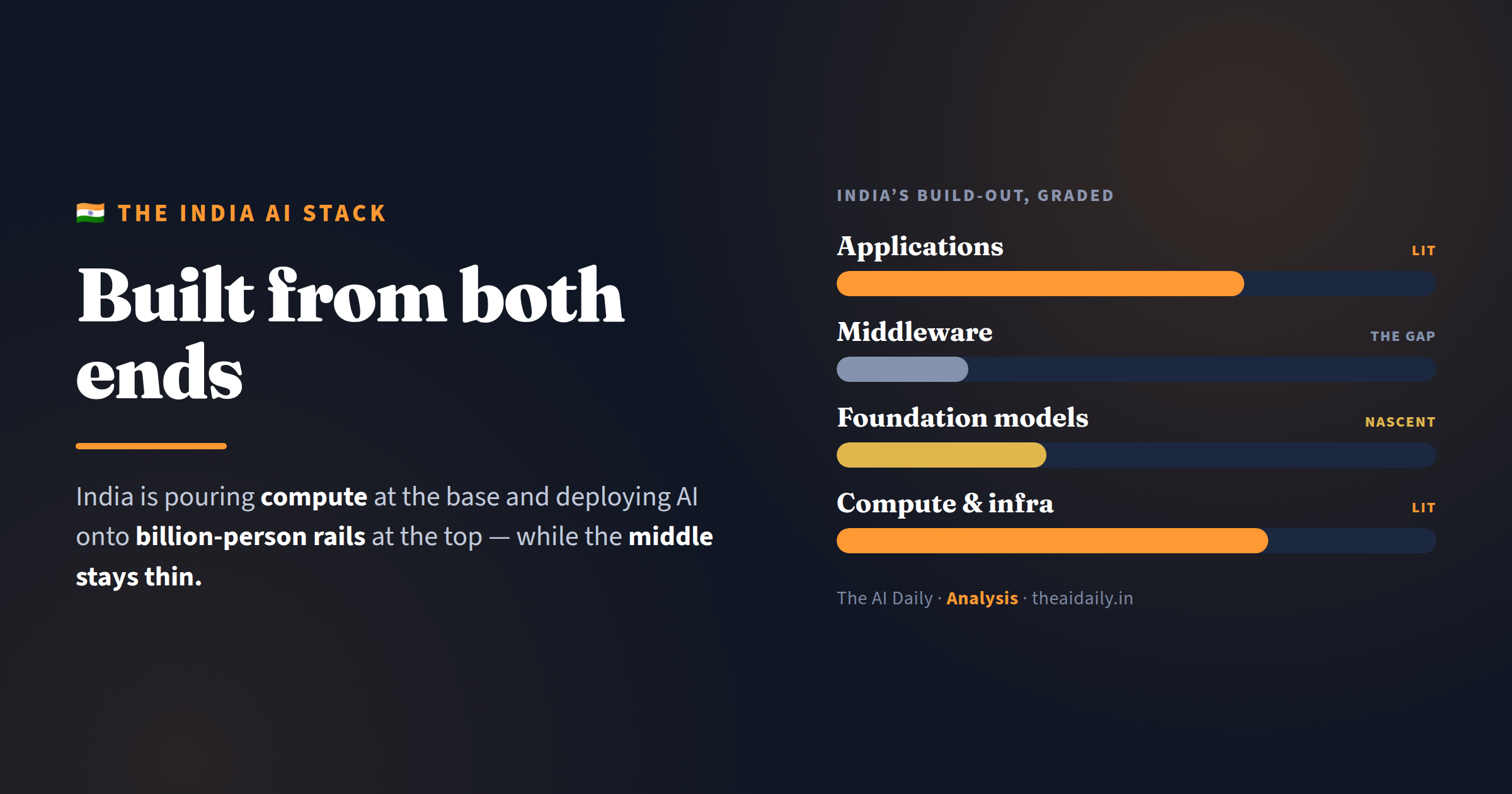
TCS just committed $7.4 billion to a single Hyderabad campus. Map India’s GenAI push onto the four layers we track and a clear shape appears: strong at the bottom (compute) and the top (population-scale apps), thin in the middle (models, middleware) — almost the inverse of how the West built it.
The one-scroll version
- One deal contains the whole thesis. A services company — TCS — is spending ₹70,000 cr (~$7.4B) to become a compute landlord. India isn’t buying its way up the stack; it’s building the ends first.
- The shape is a barbell, not a pyramid. Compute (bottom) and applications (top) are lit. Foundation models and middleware — the profitable middle the West monetised first — are the thinnest part of India’s stack.
- Compute is loud but leased. Gigawatt campuses and a ₹1.28 lakh cr chip mission are real — but they run on imported GPUs at a 15%+ premium, and on power and water India hasn’t secured yet.
- The models layer is a one-name bet. Sarvam is a genuine sovereign champion; behind it the bench is thin and the logic is sovereignty, not yet revenue.
- India’s strength is also its exposure. Its best AI-adopting sector — IT services — is the one AI is deflating 25–30%. The infra land-grab is partly a hedge against its own core business shrinking.
Start with the deal everyone read as an infrastructure headline. In early September, TCS’s subsidiary HyperVault acquired 264 acres in Hyderabad for a 1 GW, ₹70,000 crore (~$7.4–8.4 billion) AI data-centre campus — India’s largest single AI-infrastructure commitment, aimed squarely at hosting global hyperscalers and frontier labs (MediaNama, ET).
Look past the number and it’s a tell. India’s most famous services company is spending eight figures a day to become a compute landlord. That single move — a giant of the old application layer racing to pour the new foundation layer — is the whole story of India’s AI stack in miniature. To see why, map the country’s GenAI push onto the four layers we track across every other market, from the Killer App Watch. What emerges isn’t a ladder being climbed rung by rung. It’s a stack being built from both ends toward the middle.
Where India’s build-out actually stands, layer by layer
Grades are The AI Daily’s editorial read of publicly reported activity across May–September 2026, not a market-share index. Sources are linked in each section below.
Bottom layer: compute is loud — and leased
No layer is louder right now. Inside a single four-month window, India moved multiple gigawatt-class campuses from policy to committed capital: TCS HyperVault’s 1 GW in Hyderabad, Google’s 1 GW in Anakapalli, a Colt–RMZ gigawatt build in Vizag. Andhra Pradesh alone cleared ₹2.83 lakh crore (~$34B) of data-centre projects and ~3,498 MW of power (MediaNama); Amazon added $13B for India cloud and AI infra (TechCrunch); Microsoft opened its largest India data-centre hub. On chips, the Cabinet notified Semicon 2.0 at ₹1.28 lakh crore, targeting 100,000 new chip engineers (Inc42).
But read the fine print and the layer is building on borrowed silicon. The GPUs inside these campuses are imported, scarce, and getting pricier: NVIDIA’s warned 15%+ server price hike lands on India directly (Inc42), and domestic buyers describe a GPU “waiting list.” Semicon 2.0 is real money, but it funds chip design and packaging (Paras Defence’s $644M unit, Marvell’s $250M expansion) — not yet a fab printing AI accelerators. And the true ceiling isn’t land or money; it’s power and water. India is already reaching for small-modular-reactor law and BIS energy standards to feed these campuses (MediaNama). India is pouring the foundation faster than almost anyone. It just doesn’t yet make the thing that goes inside it.
India’s most famous services company is spending eight figures a day to become a compute landlord. That is the whole story in one deal.
Second layer: foundation models — a one-name bet
Go up a layer and the volume drops sharply. India has exactly one foundation-model champion with real capital and momentum: Sarvam, which became the country’s 130th unicorn on a $234M round led by HCLTech, then extended it by $74M with NVIDIA on the cap table (Inc42). It has announced a trillion-parameter roadmap and a home-hosted inference service, ships a coding agent, and has been commissioned by the government — alongside BharatGen — to build sovereign cybersecurity models (Inc42). HCLTech is even building it a dedicated ₹14,257 cr data centre in Odisha.
Behind that single name, the bench thins fast. Gnani.ai has a credible 30B Indic model inside its Artha stack; Soket is early; BharatGen’s own CEO argues “models alone can’t help India win”; and Ola’s Krutrim just cut nearly half its remaining staff. Crucially, the layer’s logic is sovereignty, not revenue: MeitY has told central ministries to pause OpenAI and Anthropic over data concerns (MediaNama), and the state may take a 1–2% stake in Sarvam directly. The trigger is fresh in memory: a US export ban on frontier models earlier this year “rattled” India’s tech community and turned sovereign AI from a talking point into a policy. This is a real bet — but it is a bet on one horse, funded by conviction about independence rather than a market that pays for Indic tokens yet.
The hollow middle: middleware barely exists
This is the thinnest part of India’s stack, and the most revealing. In every mature market, the middleware layer — orchestration, serving, agent platforms, dev tooling — is where durable margins pool; it’s the layer that just lit up globally with Palantir, Databricks and ServiceNow. In India it is almost empty. What exists is vertical, not horizontal: Razorpay’s Vulcan, a foundation model trained on payments data rather than text; Pine Labs’ protocol for agents making autonomous UPI payments; Gnani’s Plexus agent platform bundled inside its model. There is no Indian orchestration or model-serving company of scale in the record.
The upside hides in that same fact. India’s one defensible middleware asset is built on something Western labs can’t easily replicate: payments data at population scale. Vulcan understands “how money moves” across UPI in a way GPT-class models trained on the open web simply don’t. If India builds a globally interesting middle layer, it will likely grow up out of its rails — payments, identity, language — not down from generic models. For now, though, the middle is a gap.
Top layer: applications are India’s strength — and its exposure
Here India looks most convincing, and the reason is structural: it can deploy AI onto rails that already reach a billion people. The proof points are the rare kind tied to disclosed outcomes, not pilots. Bajaj Finance now runs 71% of its DIY customer service on AI and credits it with ₹2,500 crore in quarterly disbursements (MediaNama). Naukri says its AI tools lifted ARPU (MediaNama). The market regulator SEBI runs an AI system, SUDARSAN, that scans regional-language social media and filings for fraud. WhatsApp ships on-device scam detection to hundreds of millions. This is population-scale deployment, and it’s the layer where India can genuinely leapfrog.
Then comes the twist that makes the whole stack cohere. India’s single biggest AI-exposed business is the same one that built its tech economy: IT services. And AI is deflating it. Persistent’s CEO put a number on it — AI can “deflate the effort by 25% to 30%” — and the majors are already rejigging contracts from billed-hours to outcomes. LTIMindtree booked its first $150M of standalone AI revenue even as Info Edge watched Shiksha billings fall 23% to AI-changed search. That is precisely why TCS and HCLTech are sprinting into data-centre landlording: the infra land-grab at the bottom of the stack is, in part, a hedge against the application business at the top shrinking. India’s strongest layer and its most exposed layer are the same layer.
The four forces that decide it
A stack shape is a snapshot; these four cross-cutting forces are the physics that will move it. None of them sits on a single layer — each one bends the whole thing.
Sovereignty
MeitY paused OpenAI & Anthropic across central ministries; the government may take a 1–2% stake in Sarvam. The whole push was lit by the US export ban on frontier models that “rattled” India’s tech community.
Power & cost
The concrete is easy; the electrons are not. India is invoking small-modular-reactor law and BIS energy standards to feed gigawatt campuses — and paying NVIDIA’s 15%+ hardware premium on top of imported silicon.
Talent
India’s real edge. GCCs already steer $55B of IT exports; OpenAI poached Uber’s India chief to run its biggest market outside the US; Semicon 2.0 targets 100,000 new chip engineers.
Governance
The gaps are widening as fast as the capex. UIDAI updated the biometrics of ~2 crore children with consent questions; deepfake rules go largely unenforced; there is still no health-data law under the AI being deployed on patients.
The honest counter-case
Three ways this read is too neat
First, “both ends” can become “stuck at both ends.” A country can pour concrete and deploy chatbots for years without ever building the profitable middle — and the middle is where the compounding value and the sovereignty actually live. Second, imported everything is a policy, not an accident, and it has a ceiling. If GPU access tightens or prices keep climbing, the gigawatt campuses become expensive shells. Third, the app-layer “strength” is thinner than the headline names suggest — Bajaj, Naukri and SEBI are real, but most population-scale plays (DigiLocker/UMANG agents) are still at tender stage, and the sector carrying the flag is the one being deflated. The optimistic read is a barbell that fills in. The bearish read is a barbell that stays hollow while the electricity bill comes due.
So what — for people placing bets on India
Buy the rails, watch the middle
India’s durable edge is at the ends — population-scale distribution (payments, identity, language) and now compute capacity. The asymmetric opportunity is the empty middle: orchestration and serving built on top of those rails. Whoever builds India’s middleware from the UPI/Aadhaar layer up, rather than importing generic tooling, owns the scarce part.
Underwrite power, not just capex
The gating constraint on the infra story isn’t money or land — both are flowing. It’s electrons and imported silicon. Stress-test any India data-centre thesis against secured power (and its price) and GPU supply, not announced megawatts.
Separate sovereignty from returns
The models layer is a national bet with government capital behind one champion. That can be a good bet and still not be a venture return. Price Sarvam and its peers on the sovereignty mandate that funds them — and don’t assume a market that pays a premium for Indic tokens exists yet.
The bottom line
The West built its AI stack bottom-up and monetised the middle first. India is building from both ends toward the middle — pouring compute at the base and deploying AI onto billion-person rails at the top, while the foundation-model and middleware layers between them stay thin and state-backed.
TCS spending $7.4B to become a landlord is the tell: the country’s AI ambition is real, well-capitalised, and genuinely distinctive — but it is racing to fill a hollow middle before the imported silicon gets more expensive and the power runs short. Watch that middle. It’s where India’s AI decade will actually be won or lost.