Six months of curated AI signal, organized around one question: which applications have crossed from demo to deployment? We track the scaffold that makes AI possible — and the apps that prove it's necessary.
Living analysis · Updated from daily coverage · 156 issues · ~4,600 curated stories · Last updated: November 4, 2026
The stack, graded
Where the money is — demo, dollars, or default
Through the spring the money sat at the bottom of the stack; by late summer the middle lit up as middleware booked real revenue. This autumn the numbers at the bottom two layers went vertical — AMD’s biggest quarter ever at $13.4B, Anthropic booking $17B in a single quarter, Microsoft disclosing $10B of OpenAI-related revenue — and in October the market stress-tested whether that build-out can pay for itself (a ~$2T Nasdaq drawdown). Underneath the noise, the signal that matters most arrived quietly: enterprise adoption crossed an inflection — Palantir’s US commercial AI revenue passed its government business for the first time. Here’s where each of the four layers sits, on one maturity scale.
Maturity →EmergingEarly revenueScalingMature
🚀
Applications
⚡ Enterprise adoption settling in
Enterprise · Consumer · Vertical · India
Scaling
Enterprise adoption is settling into durable patterns: IT-services firms are shifting from seat licences to outcome-based pricing (Genpact now >50% of revenue), and ChatGPT crossed 1B users at 22M requests/sec. The honest counter-signal: an Apollo economist says AI has delivered “zero financial payoff” to most non-tech firms — deployment is maturing, but blanket ROI isn’t proven yet.
🔧
Middleware
⚡ Adoption crossed over
Data · Workflow · Orchestration · AI ops
Scaling
Palantir’s US commercial AI revenue overtook its government business for the first time — the cleanest sign yet that enterprise adoption has crossed a structural inflection. Databricks $7B ARR · ServiceNow $1B AI bookings · Snowflake raised guidance (+22%) behind it.
Data & ontologyPalantir +~150% · Databricks $7B ARR
Agent orchestration & connectorsStripe–OpenRouter $7B+ · MCP transport unsettled
Early revenue
AI ops — eval, observability, securityArena $100M ARR · Datadog at scale
Early revenue
🧠
Foundation Models
⚡ Revenue rocketing
OpenAI · Anthropic · Google · xAI · Mistral
Scaling fast
Anthropic booked $17B in Q3 (with an ~$895B forward purchase-commitment backlog en route to IPO); Microsoft disclosed $10B of OpenAI-related revenue in a single quarter. But the reckoning is real too: OpenAI’s actual annualized revenue landed near $50B, not the ~$70B the market had priced — and the losses are still growing.
🏗
Compute & Infrastructure
⚡ Rocketing — then stress-tested
NVIDIA · AMD · TSMC · Micron · SK Hynix
Mature
AMD posted its biggest quarter ever — $13.4B, data-center sales nearly doubled, $17B guided next · Micron data-center revenue up 11× YoY. Then October tested the financing: CoreWeave’s bonds blew out to ~15%, chip names sold off hard, and ~$2T evaporated from the Nasdaq. Demand hasn’t peaked; the question is who can pay for the build-out.
◆ The uneven windfall
Who’s actually getting more productive
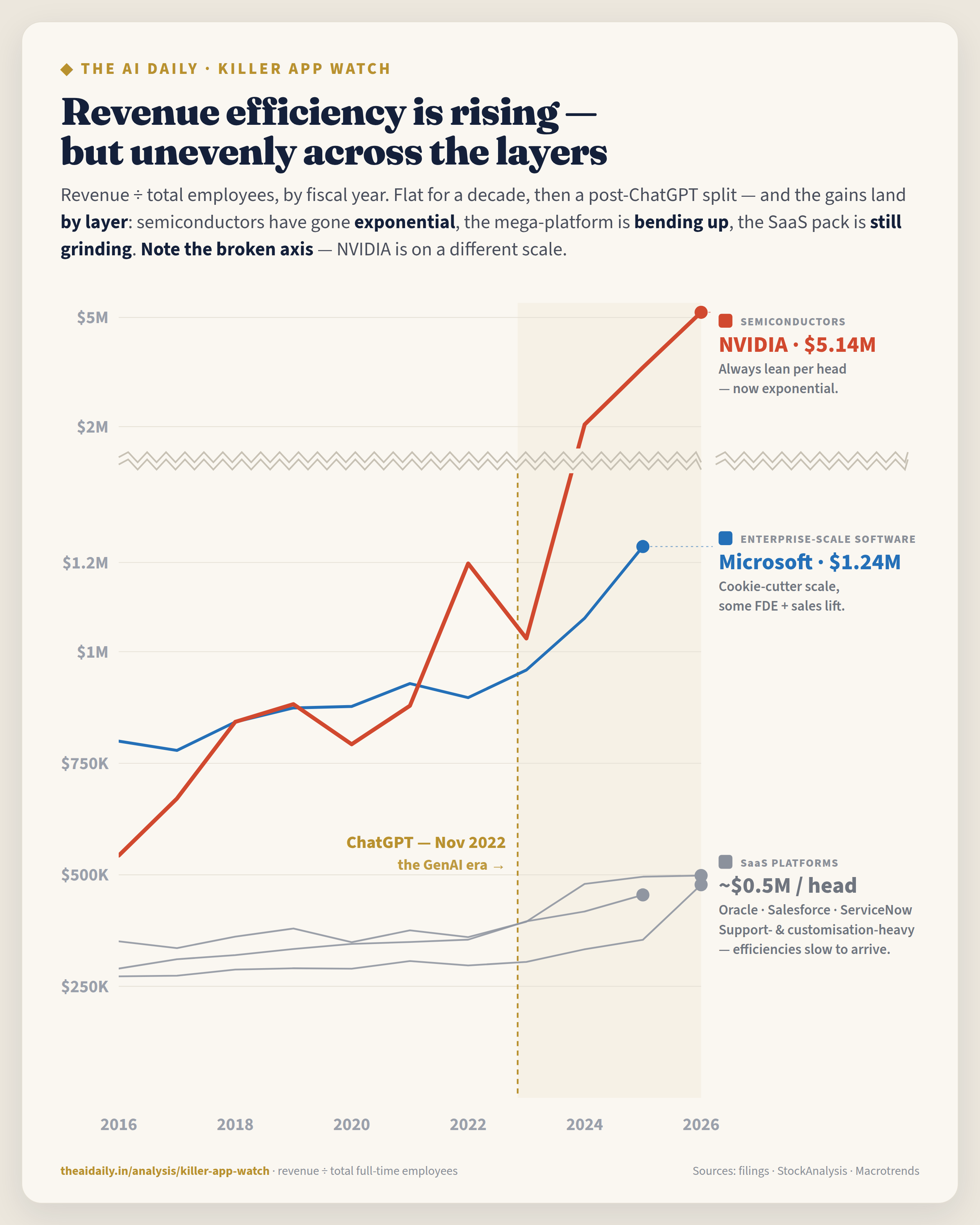
Revenue has rocketed across the stack — but revenue per employee, the cleanest read on who is genuinely getting more productive, barely moved for a decade. Then, after ChatGPT, the lines split.
The takeaway: the efficiency windfall from GenAI is landing unevenly, by layer — the semiconductor layer (NVIDIA, ~$5.14M/head, on a scale of its own) has gone exponential, and the mega-platform that monetizes the models (Microsoft, ~$1.24M) is bending up, while the application / SaaS layer (Oracle, Salesforce, ServiceNow, all near ~$0.5M) is still mostly selling software the old, labour-intensive way — the support and customisation load hasn’t lifted yet. Whether that pack catches up depends on whether AI lets it shed services-and-support headcount, not just ship AI features.
The so what
What this means for you
TL;DR — The whole stack is now a real business — and this autumn it got stress-tested. Revenue at the bottom two layers went vertical: AMD posted its biggest quarter ever ($13.4B, data-center sales nearly doubled), Micron’s data-center revenue rose 11× year on year, Anthropic booked $17B in a single quarter, and Microsoft disclosed $10B of OpenAI-related revenue. Then October asked the hard question — can the build-out pay for itself? OpenAI’s real annualized revenue came in near $50B, not the ~$70B the market had priced; CoreWeave’s bonds blew out to ~15%; roughly $2T evaporated from the Nasdaq. The signal that cut the other way arrived quietly but matters most: enterprise adoption crossed an inflection — Palantir’s US commercial AI revenue overtook its government business for the first time, and IT-services firms are repricing from seat licences to outcomes (Genpact now >50%). The honest counter-weight: an Apollo economist says AI has delivered “zero financial payoff” to most non-tech firms. “Deployed and paid” is no longer a promise at any layer — but “paid for itself” is now the question everyone’s underwriting. Select your role for what to watch.
Three moves, ranked by urgency.
AI-search cannibalization just got its proof at incumbent scale. Alphabet had its worst day ever — down 13%, ~$500B wiped out — on a search-revenue miss read as the first hard evidence AI search is eating Google’s core, and Reddit says Google’s AI Mode now drives it essentially zero referral traffic. Customers increasingly get their answer inside the AI and never reach your page. The brands that win now architect content to be cited by the model — and send the humans who do click somewhere worth landing.
Today
Pull an AI-search referral report
Alphabet losing ~$500B in a day is the macro signal; your referral report is the micro version of it. If your analytics only track Google clicks, you're blind to how much product discovery now ends inside ChatGPT, Perplexity, and Google’s AI Mode — size the gap today.
This week
Re-architect your top pages to be cited, not just ranked
Deep, factual pages get pulled into AI answers; thin ones get skipped. Take the 10 pages that drive revenue and make each the most citable source on its topic — that's how you show up when the model answers on your behalf.
This month
Audit your content for AI readability
ChatGPT, Claude, and Perplexity synthesise answers differently than Google ranks pages. The brands that win AI-mediated discovery will optimise for how AI reads their content, not just how Google indexes it.
The CFO question flipped in October — from “what does AI cost?” to “does the build-out pay for itself?” The market stress-tested the answer: OpenAI’s real annualized revenue landed near $50B against the ~$70B it had priced, CoreWeave’s bonds blew out to ~15%, and roughly $2T left the Nasdaq. Meanwhile your vendors are repricing from seat licences to outcomes (Genpact now books >50% of revenue that way), and an Apollo economist says AI has delivered “zero financial payoff” to most firms outside tech. Two jobs: underwrite your own AI ROI with a skeptic in the room, and renegotiate as the pricing model shifts under you.
Today
Re-run your AI ROI case with a skeptic in the room
An Apollo economist says AI has delivered zero financial payoff to most non-tech companies. Treat that as your stress test: for each AI program, can you point to a hard number it moved — or are you funding activity? Kill or re-scope anything that can't answer before your next board meeting.
Today
Map when your IT and SaaS contracts renew
The commercial model is shifting from seat licences to outcome-based pricing (Genpact now >50% of revenue). Where a vendor renews in the next 12 months the leverage is yours to reprice on results — and so is your exposure if clients ask the same of you. Pull the renewal calendar now.
This week
Budget the memory-cost curve into hardware refreshes
Micron's data-center revenue rose 11× as HBM demand crowds out standard DRAM, pushing memory prices up across the board. If your IT refresh lands in the next 12 months, add 15–25% to the assumption and find out today how wrong the old number is.
This month
Pressure-test the financing behind your AI vendors
October showed the build-out is debt-financed and fragile: CoreWeave's bonds hit ~15%, Microsoft cancelled a UK data-center contract, and a neocloud shakeout is forecast. If a core AI vendor is a debt-funded neocloud, your continuity depends on their balance sheet — ask to see it.
Enterprise adoption just stopped being a projection and became a trend — and the bar rose with it. Palantir’s US commercial AI revenue overtook its government business for the first time, the cleanest sign adoption has crossed an inflection. The pattern that converts is unchanged: rebuild the workflow around the agent, then prove it in a hard metric — GM tripled merged pull requests that way, and ServiceNow turned it into $1B of AI bookings in a quarter. But “deployed” no longer impresses a board; the question now is whether it’s paying for itself. Re-architect first, measure second, scale third.
Today
Ask your ops lead: where is our GM moment?
GM tripled merged pull requests not with a better model but by redesigning the workflow so agents own the 85% of work around the code. Pick your highest-volume process and ask what it looks like rebuilt around an agent — not bolted onto the old one.
This week
Name the one P&L number your AI program will move
The Palantir inflection is real commercial revenue, not pilots — and that is now the bar. Pick a single hard metric (cycle time, cost-to-serve, win rate) your AI work will move this quarter and commit to it. A program that can't name its number is activity, not strategy.
This week
Re-examine what you’re buying: seats or outcomes?
Vendors are repricing from seat licences to outcomes (Genpact now >50% of revenue). Audit your AI spend: are you paying for seats nobody opens, or for results you can measure? Push new and renewing contracts toward outcomes while the leverage is yours.
This month
Run the scaffold vs. app question across your ExCo
Your business is spending on AI infrastructure. Which of the applications tracked here map to your business lines? Which competitor is closest to deploying them? That's the strategic gap to close.
October sharpened the triage. The market punished revenue that didn’t match the story: OpenAI’s real annualized revenue (~$50B against the ~$70B priced in) tanked AI stocks, appetite for megadeals cooled (OpenAI quietly trimmed its raise toward ~$20B), and roughly $2T left the Nasdaq. But Palantir’s commercial-over-government inflection and the shift to outcome-based pricing show exactly where durable revenue is landing. Underwrite on “paid for itself,” not “AI-enabled” — and watch the balance sheet, not just the ARR.
Today
Re-underwrite on revenue conversion and cash burn, not pilots
The multiple now rewards deployed-and-paid, and October proved it punishes the gap between story and revenue. In diligence, split every holding into recurring AI revenue with real KPIs vs. still-evaluating, and put cash burn next to it — that combined delta is showing up in exits. The follow-on question stays: a credible path to the defining product in its category, or a traction story without a moat?
This week
Stress-test any infra or neocloud exposure’s financing
The fragile node is debt-financed compute: CoreWeave’s bonds hit ~15%, Microsoft cancelled a UK data-center contract, and a 200+ neocloud shakeout is forecast. If a holding or an LP co-invest sits in GPU-backed debt, model what a repricing of that risk does to it now — not at exit.
This month
Add an AI-traction score and a financing-risk flag to diligence
Build two binaries into every new deal: production-with-KPIs vs. still-evaluating, and self-funding vs. debt-dependent build-out. The first tells you whether the revenue is real; the second tells you whether it survives a credit repricing. Both now move multiples.
The AI revolution runs on two rails. The scaffold — data centers, GPUs, token cost curves, inference economics — is the foundation. The app layer is where value is actually extracted. History says the scaffold always attracts capital first; the killer apps take longer but deliver the durable returns. We track both, but the app layer is where the real race is being run.
🏗 Scaffold
Foundation models, GPU infrastructure, data centers, token costs, middleware, developer tooling. The raw capability layer. Dell reported 88% AI-server revenue growth. Inference costs fell 10× in 18 months. The scaffold is winning — the question is what it enables.
🚀 App layer
Enterprise workflow automation, consumer AI, vertical AI, and India’s population-scale plays. The value extraction layer. Agent traffic now exceeds human web traffic on Cloudflare’s network. The race is on for who captures that value.
🔧
The Stack — Middleware
6 contenders
The update: a quarter ago this was the layer “nobody demos.” Now it is booking revenue at scale — and it is the clearest new signal in this analysis. Palantir’s US commercial revenue nearly doubled, Databricks crossed $7B ARR, and ServiceNow’s AI products passed $1B in bookings. The platforms between raw models and finished apps have become a real business. But maturity is uneven: data and workflow platforms are scaling, while orchestration, connectors and AI-ops are still an early-revenue land-grab.
Palantir (data & ontology)
🔥 Heating
The hardest demand-side proof in the whole archive that AI has crossed from pilot to production. Palantir sells the ontology layer — the map between an enterprise’s messy data and the models acting on it — and when that layer’s revenue nearly doubles in a year, it is customers paying for AI outcomes, not experiments. CEO Alex Karp’s simultaneous attack on frontier-lab token pricing is also the sales pitch: buy the governed platform, not the raw tokens.
⚡
Q2 US commercial revenue up ~150% YoY; stock +12% after hours, +29% into the close; full-year guidance raised a third straight quarter (Aug 2026). The clearest demand-side proof point we’ve logged.
Databricks (data + agent platform)
🔥 Heating
The data-and-orchestration layer is now priced like a hyperscaler. Databricks sits where enterprise data meets the agents that act on it — and the market is repricing that position in real time. When a company targets a $1B raise and investors push $15B at it, the middleware layer is monetizing faster than almost anyone predicted.
⚡
Annualized revenue tops $7B; closed $5B at a $190B valuation (~27× ARR, Aug 2026) — up from $188B a month earlier. The data layer is now public-market-grade.
ServiceNow (workflow platform)
🔥 Heating
The clearest proof that enterprise workflow automation has converted from pilot to paid. ServiceNow sits in the system-of-record for IT, HR and operations, so its agents run inside the workflow rather than beside it — and customers are now paying for outcomes, not seats. When the platform layer books at this pace, “agentic workflow” stops being a category to watch and becomes a line item.
⚡
AI products crossed $1B in bookings; beat every headline metric and raised full-year subscription outlook (Jul 2026). Salesforce paid $3.6B for Fin to arm Agentforce for the same fight.
Microsoft (Copilot + implementation)
🔥 Heating
The other half of middleware is human: getting AI actually deployed inside an enterprise is where most of the year-one budget genuinely goes. Microsoft is not just shipping a product — it is funding the deployment capacity that turns a model license into a running system.
⚡
$2.5B and 6,000 employees committed to AI implementation services — an explicit bet that the bottleneck is deployment capacity, not model capability.
AI ops (Datadog, Arena, agent security)
🌿 Building
Once agents run in production, someone has to evaluate, watch and secure them — and that sub-layer is starting to print revenue of its own. It is earlier than the data and workflow platforms above it: real money, but concentrated in a few standouts rather than spread across the category.
⚡
Arena’s eval leaderboard is now a $100M ARR business; Datadog’s observability + “Bits AI” ops suite books at scale; agent-security startups raised $64–100M rounds as “agentjacking” became a production priority.
Agent connectors & routing (MCP, OpenRouter)
🌿 Building
If agents are going to call each other’s software and swap between models, the connector and routing layer is where that value accrues — and capital is already betting it is durable infrastructure. But it is the least settled part of middleware: the standards are still forming.
⚡
Stripe is acquiring model-router OpenRouter (one API to 400+ models) for $7B+ — yet MCP still lacks a settled transport standard, and enterprises now run ~3 orchestration platforms they can’t cost-meter.
🧠
The Stack — Models
3 contenders
Anthropic (Claude)
🔥 Heating
Moving in two directions at once: down into infrastructure it controls, and out into surfaces end users touch directly. Claude Cowork on mobile and web is the first serious attempt to put a frontier model in front of non-developers as a working surface rather than a chat box.
⚡
$17B in Q3 revenue, with an S-1 now on file — behind it an ~$895B forward purchase-commitment backlog and a $63B Broadcom chip-financing facility. Revenue is rocketing; so are the losses. Compute, model and application layer, all scaling at once.
OpenAI (GPT-5.x)
🔥 Heating
Distribution is the story, not the benchmark. Becoming the default model inside Microsoft 365 puts a frontier model in front of enterprise seat counts no standalone product can reach — the model layer winning by being embedded rather than chosen.
⚡
Microsoft booked $10B of OpenAI-related revenue in one quarter — concrete proof of the model layer’s enterprise weight. But OpenAI’s own annualized revenue landed near $50B, not the ~$70B assumed, and it quietly trimmed its raise toward ~$20B — the first sign appetite for AI megadeals may be cooling.
Google (Gemini)
🔥 Heating
The only player present at every layer of this analysis at once — silicon design, frontier model, search distribution, and the India population-scale deployments. That breadth is the thesis and the risk.
⚡
Alphabet had its worst day ever — down 13%, ~$500B wiped out — on a search-revenue miss read as the first hard evidence that AI search is eating Google’s core. Gemini 4 keeps shipping across the stack; the breadth that is the thesis is now also the exposure.
🏗
The Stack — Infrastructure
3 contenders
AMD (accelerators)
🔥 Heating
The clearest single read on whether infrastructure demand has peaked — and the answer, as of November, is no. A credible number-two in AI accelerators posting a record quarter with data-center sales nearly doubling is the market telling you the compute build-out still has room to run, even after the October wobble.
⚡
Biggest quarter ever — $13.4B revenue, data-center sales nearly doubled, $17B guided next — and AMD crossed a $1T market cap on the way. The clearest proof yet that AI-infrastructure demand hasn’t peaked.
Micron (HBM memory)
🔥 Heating
The constraint the whole stack runs through. High-bandwidth memory is what lets a GPU feed a model fast enough to answer, and HBM supply — not chip design — is the binding limit on inference capacity. When memory revenue goes vertical, that is the market pricing scarcity at the very bottom of the stack, and HBM demand is now crowding out standard DRAM.
⚡
Data-center revenue up 11× year on year; the stock up ~500% in a year — HBM supply remains the binding constraint on frontier AI, and the scarcity is now showing up in memory prices across the board.
The build-out’s financing test
⚠️ Watch
The demand is real; the question October forced is who pays for the capacity. The build-out is increasingly debt-financed — neoclouds borrowing against GPUs, chipmakers acting as lenders — so a repricing of risk hits this layer first. This is the single most important thing to watch at the base of the stack: not whether demand holds, but whether the financing does.
⚡
CoreWeave’s bonds blew out to ~15% and ~$2T evaporated from the Nasdaq in October — Microsoft even cancelled a UK data-center contract, and Musk warned 200+ neoclouds face a shakeout. Demand hasn’t cracked; the financing just got stress-tested.
💻
Enterprise AI — Developer Productivity
3 contenders
Cursor (AI coding IDE)
🔥 Heating
The clearest enterprise killer app of the AI era. Cursor shifted from a clever IDE plugin to core developer infrastructure — fast enough that SpaceX acquired it for $60B in stock, the largest AI software acquisition on record. The thesis: AI-assisted coding is no longer a productivity enhancement, it's the default way software gets written.
⚡
SpaceX acquired Cursor for $60B; mobile app now live — the biggest AI software deal ever signals developer tools are strategic infrastructure. Cursor’s June 30 mobile app launch lets developers supervise autonomous coding agents remotely, removing the last friction in the human-in-the-loop workflow. Claude Code is tripling engineering output at Anthropic. Security surface expanding: supply-chain agentjacking attacks via compromised Sentry integrations are now documented in production — the toolchain, not the model, is the new threat vector.
Lovable (AI-native app creation)
🔥 Heating
The vibe-coding platform that turns natural language into production web apps. Lovable represents a new category: AI-native development for non-engineers. At $500M ARR and 1M new projects per week, it's crossed the threshold from novelty to category-defining. The signed multi-year Google Cloud deal (5× usage expansion) suggests this is durable, not a spike.
⚡
$500M ARR, 1 million new projects per week — AI-native app creation is scaling into a mainstream software development category. Google Cloud multi-year deal targeting 5× usage expansion.
OpenAI Codex (enterprise coding agents)
🔥 Heating
OpenAI's answer to Cursor — built for enterprise with role-specific plugins and agent-persistence. Samsung's global deployment of ChatGPT Enterprise plus Codex to all employees worldwide (June 22) is the first large-scale proof that enterprise AI coding agents are now standard infrastructure, not a pilot. OpenAI is now moving into hardware: a July 15 teaser hints at a physical keyboard-style device purpose-built for Codex workflows, signaling the platform ambitions extend beyond software.
⚡
Samsung deploys ChatGPT Enterprise + Codex globally; hardware coming July 15 — one of OpenAI's largest enterprise deployments covers all Samsung employees worldwide. OpenAI teased a physical keyboard-style Codex device, extending the platform into hardware. Acquired Ona for agent-persistence; enterprise role-specific plugin ecosystem in production.
⚙
Enterprise AI — Agentic Workflows
11 contenders
ServiceNow (AI workflow platform)
🔥 Heating
The clearest revenue-scale proof yet that enterprise agentic workflow has converted from pilot to paid. ServiceNow sits in the system-of-record for IT, HR and operations, so its agents run inside the workflow rather than beside it — and customers are now paying for outcomes, not seats. When the platform layer books at this pace, “agentic workflow” stops being a category to watch and becomes a line item.
⚡
Crossed $1B in AI product bookings in a single quarter — the fortnight’s single biggest signal that enterprise AI-workflow automation is now paid production, not demo (SiliconAngle, Jul 2026).
Visa + Anthropic (Claude Mythos)
🔥 Heating
A named, high-stakes agentic deployment in the least forgiving environment there is. Visa put Claude to work hunting bugs across its 200-country payments network — and open-sourced the harness — while Mastercard is re-architecting its 175-billion-transaction fraud system around agents as legitimate buyers, not just threats. When the payment rails trust agents in production, the “is it safe enough for regulated work” debate has a live answer.
⚡
Claude in production across Visa’s 200-country network; Mastercard re-building a 175B-transaction fraud engine for agents (VentureBeat, Jul 2026).
TCS + Anthropic Claude
🔥 Heating
The world's largest IT services firm bets its entire delivery model on Claude. TCS becoming Anthropic's #1 global partner isn't a marketing move — it's a structural shift in how 600,000+ consultants will service enterprise clients. When TCS deploys Claude to 50,000 staff as step one, the template for every IT services firm in the world becomes visible.
⚡
50,000 TCS employees on Claude, Anthropic's top global partner — India's largest IT firm positions at the center of enterprise AI delivery globally.
MassMutual AI platform
🔥 Heating
The insurance giant quietly built the most defensible enterprise AI architecture: 12-month contracts, multi-model switching, and a complete independence layer from any single frontier provider. The result is 30% productivity gains with zero lock-in. This is the blueprint for how large enterprises will buy AI over the next five years — and MassMutual is three years ahead of competitors that are still running pilots.
⚡
30% productivity gains in production, multi-model architecture live — 12-month contracts, zero vendor lock-in, measurable gains across operations.
Adobe Creative Cloud (agentic)
🔥 Heating
Adobe's move isn't adding AI features to Creative Cloud — it's embedding full production orchestration across all 33M+ users. The shift from generative features to agentic workflow automation means creative work is now being delegated end-to-end. When the tools that most knowledge workers spend their day inside become agentic, the category is no longer "enterprise AI tool" — it's just how work gets done.
⚡
Agentic workflows deployed across all Creative Cloud products — full production orchestration for Adobe's 33M+ users, not a feature flag.
Travelers Insurance (AI claims)
🌿 Building
Nationwide AI claims processing is the canonical example of AI transforming a high-volume, rules-heavy enterprise workflow. Insurance is the canary: if AI can handle the full claims intake and routing pipeline at Travelers' scale, it validates the thesis for every other regulated industry vertical. The interesting question is what happens to claims adjusters.
⚡
Nationwide AI claims deployment in production across Travelers' full U.S. customer base — insurance as the first regulated vertical to go full production.
Morgan Stanley wealth platform
🔥 Heating
Morgan Stanley opened its internal wealth management AI platform to external AI agents — and then deployed constrained AI agents in P&L reconciliation, cutting workload by 50%. The counterintuitive finding that defined the deployment: deliberately reducing agent autonomy was the key to unlocking the 50% efficiency gain. This is the enterprise deployment template — not maximum autonomy, but calibrated autonomy with measurable guardrails in the most unforgiving workflows. The trust-and-verify pattern Morgan Stanley used is now the playbook every CFO should be running.
⚡
50% P&L reconciliation workload cut via constrained agents — a live production deployment in one of banking’s most unforgiving workflows, validated July 2026. Wealth management platform also now open to external AI agents. Architecture decision: reduced autonomy was the accelerant, not the blocker.
Salesforce Agentforce
🔥 Heating
Salesforce's $3.6B acquisition of Fin — the enterprise AI customer service platform — to power Agentforce is the clearest signal that the enterprise agentic workflow market is consolidating around CRM incumbents. Agentforce now has both the distribution (150,000+ enterprise customers) and the specialist AI layer (Fin's pre-trained CS agents). The thesis: agentic AI in customer operations isn't a feature add, it's the new contract renewal argument. When Salesforce buys a pure-play AI vendor for $3.6B, the market is telling you the category is real.
⚡
$3.6B Fin acquisition to power Agentforce — Salesforce consolidates enterprise AI customer service under its CRM umbrella; 150,000+ enterprise customers become the distribution layer for agentic workflows.
Infosys AI (enterprise services)
🔥 Heating
While Accenture fell 18% on AI headcount warnings, Infosys chair Nandan Nilekani made the contrarian case at AWS Summit NYC: AI will amplify IT services demand, not replace it. The numbers back it up — $1B in AI-attributable revenue with 90% of top clients already engaged. The new signal as of June 30: enterprise clients globally are forcing mid-term IT contract renegotiations to extract AI efficiency gains. This is a double-edged dynamic — Infosys wins new mandates where it has a credible AI answer, but faces pressure on legacy contracts. The firms that navigate this split win the next decade.
⚡
$1B AI revenue, 90% of top clients engaged; enterprise clients forcing mid-contract AI renegotiations — Infosys positions as enterprise AI delivery layer. Direct contrast to Accenture selloff. New dynamic: AI efficiency is now a contractual expectation, not a pilot outcome.
Shopify AI stack (vendor-agnostic enterprise AI)
🔥 Heating
Shopify built an AI infrastructure layer that doesn't care which model wins — automatic failover across providers, deployed to all engineers. As model churn accelerates (providers deprecating versions, changing APIs, going dark — and now governments suspending frontier model exports), Shopify's LLM proxy architecture is the emerging enterprise playbook for AI vendor risk management. The companies that build this independence layer now will be able to adopt the best model at each price point without re-engineering their stack. Those that don't will face an AI vendor lock-in crisis within 24 months.
⚡
Deployed to all Shopify engineers with automatic failover across providers — vendor-agnostic AI infrastructure in production; the model-neutral enterprise playbook. Now also the geopolitical-risk playbook: the Fable 5/Mythos export suspension proved frontier model access can be cut by executive order.
Square + AI commerce (ChatGPT / Claude ordering)
🔥 Heating
Square launched a ChatGPT and Claude integration that lets consumers place restaurant orders directly through AI chat — with no setup fee and low transaction rates. This is agentic commerce crossing into live production for a mass-market transactional context: the first time AI agents complete a commercial transaction end-to-end, in real restaurants, with real money, at scale. It combines Square’s merchant network (millions of restaurants) with the conversational reach of ChatGPT and Claude. The natural language ordering interface replaces the browse-and-tap flow with a conversation — and it’s already live. Whatever your industry’s transactional equivalent is, the template just shipped.
⚡
ChatGPT and Claude can now place restaurant orders through Square, live July 2026 — no setup fee, low transaction rate, agentic commerce in production at mass-market scale. The browse-and-tap flow is being replaced by conversation in millions of merchant locations.
📱
Consumer AI
5 contenders
The update: consumer AI just found its business model. When OpenAI launched ads in ChatGPT, many called it a distraction. Then the ad engine crossed a $1B annualized run-rate in under a year — advertisers now treat ChatGPT as a real media channel, reaching users at the moment of intent. The consumer layer isn’t just scaling reach (1B+ users); it’s monetizing. That’s the top of the stack lighting up — the same pattern the middleware layer showed a quarter ago.
OpenAI (ChatGPT Ads)
🔥 Heating
The clearest proof yet that consumer AI has a business model beyond subscriptions. From launch to a ten-figure annualized run-rate in under a year is an extraordinary ramp — and it reframes ChatGPT as an advertising platform reaching users at the precise moment of intent, something even Google search struggled to replicate. OpenAI is de-risking its model ahead of an IPO. The risk to watch is the one Anthropic is already needling: once ad incentives enter the answer, ChatGPT’s perceived neutrality gets harder to hold.
⚡
ChatGPT Ads crossed $1B in annualized revenue run-rate (Aug 2026), expanding globally — including an India rollout on free/low-cost tiers to monetize a 1.4B-person market. Consumer AI monetization is no longer a promise.
Perplexity (AI search)
🔥 Heating
The clearest consumer AI success story outside of ChatGPT. Perplexity's hybrid local-cloud inference architecture solves the latency problem for AI search on consumer hardware. At 100M+ MAU and a 2028 IPO target, it's crossed the consumer threshold. The structural shift happened in June 2026: ChatGPT's global market share dropped below 50% for the first time, while Claude grew 452% year-on-year. The AI search market is now genuinely contested — not a one-player category.
⚡
100M+ monthly active users, ChatGPT share drops below 50% for first time — the consumer AI market fragmented in June 2026; Claude grew 452% YoY. AI search is now a multi-player race, not a default.
Waymo (autonomous mobility)
🔥 Heating
Waymo is the only autonomous vehicle company that has successfully monetized at consumer scale in a major U.S. city. The Phoenix Uber pilot ending in June 2026 — with Waymo vehicles pivoting directly to autonomous DoorDash deliveries — signals the thesis is evolving: autonomous mobility serves both ride-hail and last-mile delivery, and the platform value compounds across use cases. The question has shifted from “can it work” to “how fast can it scale across modes.”
⚡
100k+ weekly rides, premium subscription tier launched, now also autonomous DoorDash deliveries in Phoenix — ride-hail and last-mile delivery from the same autonomous fleet. Expanding geofenced coverage across multiple major U.S. cities.
Apple Siri AI
👀 Watch
WWDC's Siri reveal was the most anticipated consumer AI launch of the year — and the most consequential for the app layer. Apple has 2.2B active devices. When AI is native to the OS, the platform becomes the killer app. The early reviews were positive; the stock dropped anyway. Investors are skeptical about timeline execution. The EU regulatory block is a real near-term constraint. Watch for actual rollout metrics Q3 2026.
⚡
AI features rolling out across Camera, Photos, Safari, Health — but EU DMA compliance blocking European launch; investor skepticism on execution pace.
DoorDash AI ordering
🌿 Building
Natural language ordering for food delivery is a small but structurally important consumer AI deployment: the first time AI replaces the menu-browse-tap-confirm flow with a conversational one for a mass-market consumer service. DoorDash's deployment is real-world validation that AI can reduce friction at consumer scale in a transactional context. The Waymo DoorDash autonomous delivery signal from Phoenix adds a second AI layer to the same service: not just how you order, but how the order is delivered.
⚡
Natural-language ordering chatbot deployed across DoorDash; autonomous Waymo deliveries live in Phoenix — AI is now embedded in both the ordering interface and the delivery layer of the same consumer service.
🇮🇳
India & Population-Scale AI
7 contenders
Why India gets its own category: India is the only market where AI deployment can be simultaneously enterprise, consumer, and government at population scale — and where the sovereign AI question is most live. Reliance alone touches 500M people. A deployment decision here is categorically different from a U.S. enterprise contract. New signal — sovereign AI vulnerability: When the US suspended Anthropic’s Mythos 5 export access for two weeks (June 2026), India’s MeitY publicly demanded guarantees of stable, uninterrupted AI access from the US. The episode exposed a structural dependency: frontier AI access can be cut by executive order, and nations are now treating AI continuity as a geopolitical risk. Sarvam’s unicorn raise and India’s $15B Semiconductor Mission 2.0 are the direct responses. OpenAI, meanwhile, appointed Prabhjeet Singh (ex-Uber India chief) as India MD — its largest market outside the US is now a named priority with dedicated leadership.
Jio AI (Reliance)
🔥 Heating
Mukesh Ambani's bet: embed AI into every Jio call, app, and home. Jio's 500M-user telecom network is the distribution layer for what could become the world's largest AI-native consumer deployment. The stakes became concrete in June 2026 when Jio filed its IPO DRHP — and disclosed nine distinct AI initiatives spanning autonomous networks, enterprise cloud, and consumer AI applications. For the first time, Jio's AI roadmap is public record, not rumor.
⚡
Network-level AI agent confirmed live on all Jio user calls — June 2026 confirmation that the agent is active at scale, not just disclosed in the IPO DRHP. 9 AI initiatives now spanning networks, enterprise cloud, and consumer apps; 500M-user distribution layer with operational AI, not just roadmap speculation.
Sarvam (India sovereign LLM)
🔥 Heating
India's best-funded indigenous AI model company crossed the unicorn threshold on a $234M HCLTech-led round — timed precisely as U.S. export controls restricted Anthropic's most advanced models. Sarvam's Indic-language capabilities address a structural gap in frontier models: none of them are optimized for the 22 scheduled languages of India. The sovereign AI thesis just got its first unicorn validation, and the Mythos 5 suspension made the strategic case even clearer.
⚡
$234M unicorn round led by HCLTech — India's first indigenous AI model company to reach unicorn status, positioned as the alternative to restricted U.S. frontier models. Timing: raised during the Anthropic Mythos/Fable export ban.
Pine Labs P3P (agentic payments)
👀 Watch
Pine Labs launched the world's first agentic UPI payments protocol — P3P lets AI agents autonomously execute UPI transactions on behalf of users. This is a global first in fintech: an AI agent completing a financial transaction without human confirmation in the loop. The regulatory questions are enormous (who is liable when an agent mispays?), but the commercial thesis is compelling: agentic commerce at India's 200M+ UPI-enabled user base. The NPCI chief explicitly signalled in June 2026 that AI will be central to the next era of UPI expansion.
⚡
World's first agentic UPI payment protocol in production; NPCI chief signals AI as next UPI growth driver — AI agents autonomously executing transactions; regulatory framework still being written. India’s payments infrastructure chief has put AI at the centre of the next phase of growth.
StockGro Stoxo (retail investor AI)
🌿 Building
India has 80M+ retail investors, the fastest-growing retail investor base in the world. StockGro's custom AI model Stoxo targets this market with AI-driven trading guidance. This is the Indian equivalent of what Robinhood did for U.S. retail investing — but with AI native to the product from day one. The winning AI in Indian retail finance will reach more people than any U.S. financial AI product by orders of magnitude.
⚡
Custom AI model Stoxo in production for India's 80M+ retail investors — targeting the world's fastest-growing retail investor base with AI-native guidance.
Nykaa + OpenAI (conversational commerce)
🌿 Building
India's leading beauty and fashion platform embedded ChatGPT-powered discovery across its product catalog. Conversational shopping — replacing browse and filter with natural language — has been tried in the West with mixed results. In India, where a majority of users are mobile-first and language-diverse, the conversational interface may actually be the right UI. Nykaa's multi-year deal is a long-term bet on the conversational commerce thesis in emerging markets.
⚡
Multi-year OpenAI deal, conversational AI across beauty and fashion catalog — India's largest beauty platform bets on conversational commerce for mobile-first users.
Aarogya Setu 2.0 (national health AI)
🔥 Heating
India's national health app — already on 500M+ devices — relaunched in July 2026 with Google's Gemma model embedded to AI-power the digitization of health records under the Ayushman Bharat Digital Mission (ABDM) framework. This is government AI at a scale no other country has attempted: a single deployment that touches half a billion citizens’ health data, processing it through an on-device LLM for privacy. When a government deploys AI to health records at 500M-citizen scale, it sets a new baseline for what population-scale AI actually means.
⚡
Google Gemma embedded in Aarogya Setu 2.0 for national health record digitization, 500M+ citizens — live July 2026 under the ABDM framework. On-device AI for health data at national scale. No comparable government health AI deployment exists anywhere in the world at this citizen reach.
India Government Surveillance AI (Telangana)
🌿 Building
Telangana police are running two distinct AI deployments simultaneously: C-SIGHT, an air-gapped AI system for child sexual abuse material investigations (98% accuracy, under 20 minutes offline, deployed June 2026), and AI-powered facial recognition drones now used for routine Hyderabad street patrols (July 2026). Together they represent the first state-level deployment of both investigative and surveillance AI in India at production scale. The civil liberties questions are significant and largely unresolved — but the deployments are live, not proposed. Government AI in India is moving faster than regulatory frameworks, and Telangana is the leading edge.
⚡
C-SIGHT air-gapped AI live (98% accuracy, <20 min) + facial-recognition drones for routine street patrol, both in production — two live government AI deployments in a single Indian state. C-SIGHT is air-gapped for security; drones are live on Hyderabad streets. Regulatory framework for surveillance AI still being written.
🏫
Vertical AI
8 contenders
Autonomous mobility (Zoox / Tesla)
🔥 Heating
Robotaxi crossed from “permitted pilot” to “paid, no-safety-driver commercial service.” Amazon’s Zoox secured a federal exemption to run steering-wheel-free vehicles for hire in Las Vegas — a genuine regulatory-and-commercial line, not another test fleet — while Tesla stood up robotaxi pilots in Orlando and Tampa. The question for the vertical is no longer “can the car drive itself” but “who scales the paid network first.”
⚡
Zoox cleared for paid, steering-wheel-free robotaxi service in Las Vegas (federal exemption) — a landmark commercial deployment; Tesla robotaxi pilots live in Orlando and Tampa (Wired / TechCrunch, Jul 2026).
Healthcare AI (AdventHealth / OpenAI / Anthropic)
🔥 Heating
Healthcare is the vertical where AI has the clearest value thesis (vast documentation burden, diagnostic complexity, scheduling inefficiency) and the highest trust bar. AdventHealth's enterprise OpenAI deployment and OpenAI's rare-disease diagnostic work represent two ends of the healthcare AI spectrum. The June 2026 signal that matters most: OpenAI's AI independently diagnosed 18 new rare childhood diseases — not in a lab demo, but in real clinical cases where human physicians had previously missed the diagnosis. And in July 2026, Anthropic launched a Claude Science drug discovery program and workbench, joining the pharma AI race with a dedicated computational research platform. Healthcare AI is now a contested vertical among every major frontier lab.
⚡
OpenAI AI diagnoses 18 new rare childhood diseases; Anthropic launches Claude Science drug discovery program — clinical validation, not demo; cases where human physicians previously missed the diagnosis. AdventHealth enterprise deployment live. Anthropic’s Claude Science workbench targets computational research as a full workflow replacement.
Legal AI (document + discovery)
🌿 Building
Legal AI is in the awkward phase: the technology clearly works for document review, contract analysis, and due diligence, but the liability question (who is responsible for a hallucinated clause?) is keeping large law firms cautious. KPMG's retraction of an AI-generated report is the cautionary tale that every legal AI vendor has to address. A new signal from June 2026: prosecutors successfully used ChatGPT conversation logs as evidence in a criminal arson trial — the first time AI data was admitted in criminal prosecution. AI is now both a legal tool and a source of legal evidence.
⚡
ChatGPT logs admitted as prosecution evidence in Palisades fire arson trial, June 2026 — first time AI conversation data used in criminal prosecution, setting a legal precedent. Growing enterprise adoption for document review and contract analysis, but KPMG’s AI report retraction remains the liability red flag slowing wider law firm adoption.
Financial services AI (JPMorgan / Deutsche Bank / Morgan Stanley)
🔥 Heating
Financial services is moving from AI pilots to production deployments faster than any other regulated vertical. JPMorgan is crossing "commercial thresholds" for agentic AI. Deutsche Bank is reporting concrete project-acceleration. And Morgan Stanley's P&L reconciliation deployment — cutting workload 50% using deliberately constrained agents — is now the most concrete traction signal in the sector. The pattern: large banks are deploying AI for internal workflows first (research, compliance, code, documentation, reconciliation) and building trust before expanding to client-facing functions. The direction is clear; the constraint is autonomy design, not technology capability.
⚡
JPMorgan agentic AI at “commercial thresholds”; Morgan Stanley cuts P&L reconciliation 50% via constrained agents; Deutsche Bank project-acceleration in production — finance is the fastest-moving regulated vertical, and constrained agent design is the winning deployment pattern.
Cybersecurity AI (Palo Alto / CrowdStrike)
🔥 Heating
Palo Alto Networks and CrowdStrike both reported their best-ever quarter in June 2026 — explicitly driven by AI-fuelled threat proliferation. This is the vertical where AI ROI is most unambiguous: AI is simultaneously creating the threat and the defence. The alternative to AI-powered cybersecurity isn’t “do it manually” — it’s “get compromised.” Every enterprise deploying AI coding agents is also expanding its attack surface (the Sentry/Claude Code agentjacking incident is the proof of concept). Cybersecurity AI is not a nice-to-have; it is the direct consequence of deploying every other AI on this list.
⚡
Palo Alto Networks and CrowdStrike both post best-ever quarters, explicitly driven by AI threat proliferation, Q2 2026 — AI creates the threat and the defence simultaneously. Supply-chain agentjacking documented in production (Sentry/Claude Code). Straiker raised $64M for agentic-specific security. This is the fastest-growing AI vertical by revenue acceleration.
Sports & entertainment AI (Fanatics / Gemini)
🌿 Building
The combination of Fanatics' real-time AI personalization at consumer scale and Google Gemini embedded in Argentina's World Cup preparation suggests sports is a genuine AI vertical — not just a marketing use case. The thesis: sports generates vast real-time data (player stats, in-game events, fan engagement), and the willingness-to-pay for personalized sports experiences is proven. The first company to build a full AI-native sports intelligence layer wins a large, loyal audience.
⚡
Fanatics AI personalization at consumer scale; Gemini in Argentina's World Cup prep — sports emerging as a high-engagement AI vertical with proven willingness-to-pay.
Media & Entertainment AI (A24 / Google DeepMind)
👀 Watch
Google DeepMind's $75M investment in A24 — the studio that defined prestige independent film for a generation — signals that creative media is now an explicit AI vertical, not a battleground. Studios that spent two years fighting AI in court are now accepting capital from the AI labs. The deal is strategic for both sides: A24 gets AI-native production infrastructure; DeepMind gets a content pipeline and cultural legitimacy. Combined with OpenAI's Hollywood deals, the pattern is clear — the film and TV industry is negotiating terms rather than holding the line. Watch for which studio builds the first fully AI-augmented production pipeline.
⚡
$75M Google DeepMind investment in A24 — studios that fought AI are now taking AI capital. Media & Entertainment is emerging as a named vertical, not just a copyright battleground.
Trunk Tools (construction document AI)
🔥 Heating NEW
The cleanest before/after number in this refresh, from an industry nobody lists as an AI category. Construction document review is exactly the shape that AI is good at right now: high-volume, rules-heavy, painfully manual, and expensive when it goes wrong.
⚡
Document review cut from 60 days to 10 — a 6× cycle-time reduction in production, not a pilot. The Morgan Stanley template working outside financial services.
The scaffold story is largely written — though October added a sharp new chapter on how it gets financed. GPU supply is real, token costs are falling, inference is commoditizing. The question that will define the next 18 months is which applications have earned the right to be called killer apps — not just impressive demos, but products that have crossed to production, generated measurable value, and created switching costs. Half a year in: no clear winner yet in any category.
The biggest shift since our last update is that revenue at the bottom two layers went vertical — and then got stress-tested. AMD posted its biggest quarter ever with data-center sales nearly doubling; Micron’s data-center revenue rose 11× year on year; Anthropic booked $17B in a single quarter with an ~$895B forward-commitment backlog; Microsoft disclosed $10B of OpenAI-related revenue. For a year the debate was “chips are real, but is anyone above them making this pay?” The numbers answered it. Then October asked the harder question — can the build-out pay for itself? OpenAI’s real annualized revenue came in near $50B, not the ~$70B the market had priced; CoreWeave’s bonds blew out to ~15%; roughly $2T evaporated from the Nasdaq. The demand is not in doubt. The financing is what to watch.
And this is the update where enterprise adoption stopped being a projection and became a trend. Palantir’s US commercial AI revenue overtook its government business for the first time — the cleanest single data point that adoption has crossed a structural inflection. Underneath it, the commercial model is changing: IT-services firms are repricing from seat licences to outcomes (Genpact now books >50% of revenue that way), TCS’s AI revenue crossed 10% of total, and the middleware layer kept scaling (Databricks $7B ARR, ServiceNow $1B bookings, Snowflake raising guidance). The honest counter-weight, which we’d be wrong to bury: an Apollo economist argues AI has delivered “zero financial payoff” to most companies outside tech, and the World Bank found only 23% of Indian formal firms actually use it. Adoption is maturing and stabilising — but “stabilising” means settling into real, uneven patterns, not a universal win.
That isn't pessimism — it's precision. Traction is not the same as dominance. Cursor is impressive; developers love it; SpaceX acquired it. But “developers love it” is not a killer app — it's a strong contender. Morgan Stanley's 50% P&L reconciliation reduction is the most concrete enterprise traction signal in our tracking period. It's also one constrained workflow at one bank. Waymo runs 50,000 rides a week across three cities. Uber runs 20 million a day globally. Palo Alto and CrowdStrike posted record quarters — because AI is generating the attacks, not because a new defensive AI product has won. Aarogya Setu 2.0 is a genuine population-scale deployment, but it's government infrastructure, not a killer app in the commercial sense. Strong signals everywhere. No category winner anywhere.
The standard matters. A killer app isn't a product with good NPS and a Fortune 500 pilot. It's a product that redefines what the underlying platform is for — the way email redefined the internet, WhatsApp redefined mobile, or Uber redefined GPS. By that standard, every category in this tracker has compelling contenders and no winner yet. The race is live. The finish line is real. Nobody has crossed it.
The most important deployment signal isn't a winner — it's a pattern, and it just sharpened. The gains come from rebuilding the workflow around the agent, then proving it in a hard number: GM tripled merged pull requests by handing agents the 85% of work around the code, and ServiceNow turned that same pattern into $1B of AI bookings in a quarter. Visa and Mastercard did it in production, in payments. Every deployment plan built around “autonomous AI” as the goal should be rewritten around “re-architect the workflow, then measure the outcome” — that is the template that is actually converting to revenue.
A new structural risk has entered the stack: the US government suspended frontier AI model access via export controls in June 2026, then reversed inside three weeks. India's MeitY publicly demanded stable access guarantees. Enterprise AI access is now a geopolitically contingent asset. No risk register has caught up to this yet. Build your independence layer — multi-model, multi-vendor, documented fallbacks — before you need it.
The consumer killer app that reaches 100M+ users doing something genuinely novel at scale — autonomous commerce, AI-native social, on-device health — hasn't shipped. That's not a failure. It's where the next wave of value is waiting to be claimed. The company that gets there first will be worth more than any of the scaffold plays combined.
Updated from 156 issues of The AI Daily, covering May 17 – November 4, 2026. This is a living analysis — traction signals update weekly.