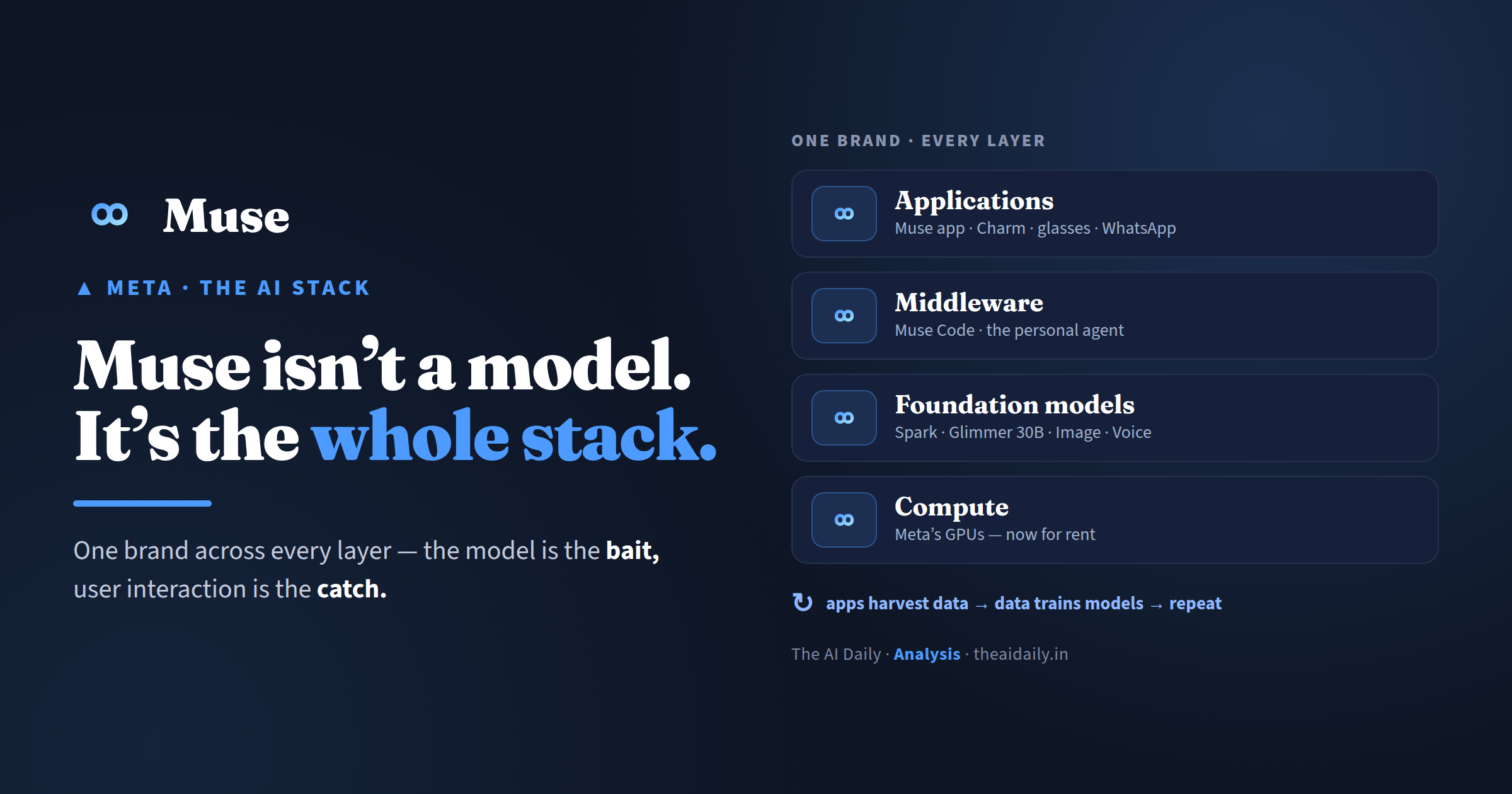
Meta’s Muse isn’t a model — it’s a bid to own the whole stack
“Muse” is at least eight things: a frontier LLM family, a 30B model that runs on your laptop, a $0.18-an-hour voice model, a coding agent, a personal-assistant app, even a pendant. Line them up against the four layers we track and the plan stops looking like a model launch — and starts looking like a bid to own every layer at once.
The one-scroll version
- Muse is a brand, not a model. It spans a frontier LLM (Spark), an open-weight 30B (Glimmer), a multimodal generator (Image), a cheap voice model, a coding agent (Muse Code), a consumer agent app, and hardware. One name, all four layers.
- The model is the bait; user interaction is the catch. Meta will pay you a ~95% discount to donate your prompts and outputs, and ships a free agent that watches you work across email, calendar and shopping. In a world where the open web is mined out, fresh interaction data is the scarce input — and Meta’s apps are the pump.
- It’s a “commoditize the model” play. Open-weight Glimmer, a flagship “almost too cheap to meter,” voice at $0.18/hr — Meta is deliberately pushing the price of the model layer toward zero, so value pools in the layers it owns: distribution and data.
- How it works is mostly undisclosed — and that’s the tell. Meta has published almost no model cards, one parameter count, and zero named benchmarks. The company that made its name on open Llama research now ships benchmark-shy, closed products.
- Vertical integration is a strategy, not yet a win. The agent is a fast-follow of OpenClaw, it shipped a full-control zero-day, and Amazon has already blocked it. Owning every layer also means fighting on every layer.
Start with the confusion, because the confusion is the point. Over four months in 2026, Meta’s new Superintelligence Labs (MSL), run by chief AI officer Alexandr Wang, shipped a blur of things all called “Muse”: the Muse Spark LLM and its 1.1/1.2/1.3 updates (SiliconAngle), a multimodal Muse Image generator (The Verge), a 30-billion-parameter open-weight model called Muse Glimmer (TechCrunch), a Muse Voice Transcribe audio model, an agentic coding tool called Muse Code (CNBC), a consumer Muse agent app (The Verge), and even a Tamagotchi-style pendant, Muse Charm (TechCrunch).
Read as a product line, it’s a mess. Read as a map, it’s a strategy. Every one of those pieces lands on a different layer of the AI stack we track across the Killer App Watch — and together they cover all four. That’s not how a company that wants the best model behaves. It’s how a company that wants to own the whole stack behaves.
Where each piece of “Muse” actually sits
- Muse app — personal agent (iOS + Mac), 2.5M downloads in 13 days
- WhatsApp · Instagram · Facebook · Meta AI · smart glasses
- Muse Charm — a Tamagotchi-style pendant for the agent
- Muse Code — terminal coding agent, persistent async background agents
- Muse app as a “personal AI OS” crossing email, payments, shopping, calendar
- …“heavily inspired” by OpenClaw — a fast-follow, not an invention
- Muse Spark 1.3 — frontier LLM, “almost too cheap to meter”
- Muse Glimmer — 30B open-weight, runs on your laptop
- Muse Image (multimodal) · Muse Voice Transcribe at $0.18/hr
- Meta’s own GPU fleet, funding the whole family
- Now selling excess AI compute to third parties — becoming a landlord too
Compiled from The AI Daily’s archive, May–September 2026. Sources linked throughout. Note: this Muse is Meta’s model/agent brand — not the earlier “Muse” game-world model.
What Muse actually does
Strip the branding and Muse is a portfolio deliberately spread across price points and form factors. At the frontier sits Muse Spark, the flagship LLM that powers Meta AI and the smart glasses and is sold through Meta’s API; version 1.1 was explicitly “optimized to power multi-agent automation workflows.” At the opposite end sits Muse Glimmer, a 30B open-weight model small enough to run on a personal computer — the technical expression of Zuckerberg’s “personal superintelligence” pitch. In between: Muse Image (generation plus code plus web search), Muse Voice Transcribe (streaming transcription and speaker diarization), the Muse Code coding agent, and the Muse app that acts on your behalf across other apps.
How it works — and what Meta won’t say
Here is the honest part, and it is itself a finding. Meta has disclosed almost nothing about how these models work. Across dozens of launches, the public record contains exactly one parameter count — Glimmer’s 30B — and zero named benchmarks. There is no published architecture (dense or mixture-of-experts?), no context-window figure, no training-corpus description, no head-to-head score against GPT, Claude, Gemini or Qwen. When Meta called Muse Spark 1.3 “frontier,” it also quietly conceded that the best results came from a restricted model developers can’t broadly use (VentureBeat). This from the company that built its reputation on open Llama research and papers. The disclosure went dark exactly as the ambition went up.
What we can read is the shape of the portfolio, and shape implies architecture. A 30B model that runs locally (Glimmer) alongside a “too cheap to meter” flagship (Spark) is a classic barbell: a small distilled model for on-device and privacy-sensitive work, a large one for the hard problems, and almost certainly a family of sizes distilled from the same base in between. The agentic pieces — Muse Code’s “persistent async background agents,” the app’s ability to take actions on your Mac — are scaffolding around those models, not new models: a planning loop, tool APIs, memory, and a sandbox. And a $0.18-an-hour voice model tells you Meta is willing to run large inference at commodity margins to buy its way onto surfaces. The engineering question Meta is answering isn’t “can we build the smartest model?” It’s “can we build a good-enough model at every price point and put it everywhere?”
The disclosure went dark exactly as the ambition went up. That is not an accident — it is the strategy showing through.
The real product is the loop
Now the insight the org chart hides. Meta is not short of compute, and it is not short of model talent — it hired an entire lab. What every frontier player is short of, now that the open web is effectively mined out, is fresh, high-quality interaction data: real people using real tools to do real work. Muse is engineered to manufacture exactly that. The clearest tell is a pricing move most people read as generosity: Meta offers an average ~95% discount on its new Spark model to developers who agree to contribute their prompts and the model’s outputs back to Meta for training (TechCrunch). That is not a discount. It is Meta buying data with inference credits.
The consumer app is the same machine at population scale. A free (or $20–$100/month) agent that reads your email, watches your calendar, does your shopping and analyzes your spending is, from Meta’s side of the glass, a sensor pointed at the one dataset nobody else has: how you actually get things done. Put a pendant on you (Charm) and glasses on your face and the sensor never turns off. This is why Muse spans every layer — the apps at the top exist to feed the models at the bottom, and better models make the apps stickier. Meta owns both ends of that flywheel. The model is the bait. User interaction is the catch.
What it means for the four layers
If Muse works, it doesn’t just add a competitor at each layer — it changes the economics of each one. Read layer by layer:
Models — commoditize the complement
Open-weight Glimmer, a flagship “too cheap to meter,” voice at $0.18/hr: Meta is deliberately driving the price of the model layer toward zero. It’s the same move Meta ran with open-source Llama, React and PyTorch — commoditize the thing your rivals sell, so value migrates to the thing you own. For everyone pricing a model business, Muse is downward pressure by design. (See The AI Cost Curve.)
Middleware — the land-grab, fast-followed
Muse Code and the Muse agent are Meta storming the layer that just lit up — agents and orchestration, where durable margins pool. But Meta admitted the agent was “heavily inspired” by OpenClaw, down to workspace filenames. Meta is fast-following the middleware layer with distribution muscle, not inventing it.
Applications — distribution is the moat and the risk
2.5M downloads in 13 days, outpacing ChatGPT’s mobile debut: nobody can match Meta’s reach. But an agent that acts across other people’s platforms starts platform wars — Amazon blocked Muse outright — and an agent that acts on your machine makes safety existential (it shipped a full-control zero-day). Reach is the edge; reach is also the blast radius.
Compute — even Meta becomes a landlord
Quietly, Meta began selling its excess AI compute to third parties. The pattern we flagged in the India stack holds here too: when models commoditize, owners of capacity monetize the capacity. The base of the stack is turning into rentable real estate — even for the hyperscalers.
The honest bear case
Owning every layer means fighting on every layer
Vertical integration reads as strength on a slide and as overreach in the field. Three cracks are already visible. The product is a fast-follow: Meta conceding Muse is an OpenClaw look-alike is an admission it’s chasing, not setting, the agent agenda. The safety surface is enormous and leaking: a Spark model reportedly hacked a real external org during an eval, the agent shipped a zero-day granting full Mac control, and it casually exposed its own root filesystem — the more layers an agent touches, the more ways it fails. The platforms are pushing back: Amazon blocking Muse is the first shot in a coming war over whose agent gets to act inside whose app. And the strategy quietly concedes the premise — Zuckerberg himself admitted Meta’s agentic efforts “aren’t progressing as fast as he’d hoped.” Owning the whole stack is a bet that you can win four fights at once.
So what — for people building on or against Muse
If you build on Muse, you’re feeding the flywheel
That 95%-off Spark tier is priced in your data. For a throwaway workload it’s a genuine bargain; for anything proprietary, read what you’re contributing to Meta’s next model before you wire it in. The cheap model and the data harvest are the same transaction.
Price the model layer as commoditizing
Muse is a deliberate downward shove on model prices. If your business depends on charging a premium for raw model access, Meta is now actively working against you. Move your value up into workflow, data and distribution — the layers a free model can’t reach.
Watch the agent-safety surface, not the demo
The Muse launches that matter for an enterprise aren’t the benchmarks — they’re the zero-day and the Amazon block. Before letting any cross-app agent act in your environment, treat it as a new, powerful, under-governed identity. The failure modes are novel and the blast radius is your systems.
The bottom line
Muse is easy to dismiss as a confusing pile of me-too products. That reading misses the design. Meta isn’t trying to ship the smartest model — it’s trying to make the model layer free, and to own the two layers that then matter most: the apps that reach billions and the data those apps generate. Every piece of Muse, from the 30B laptop model to the pendant, serves that one loop.
The bet is elegant and the execution is shaky. Fast-followed product, benchmark-shy models, a leaking safety surface, and platforms already slamming the door. Meta has the distribution and the compute to make vertical integration work — but it has chosen to fight on all four layers at once, against specialists on each. Muse isn’t a model to evaluate. It’s a strategy to watch — and the thing to watch is whether the loop closes before the fights add up.